
What should I know before investing in 4-bedroom oceanfront houses in Armação da Piedade, Governador Celso Ramos, Brazil?
Four-bedroom family homes in Armação da Piedade appeal to investors seeking stable rental income over speculative appreciation—they attract year-round tenants rather than seasonal occupants. Entry costs are lower than nearby Balneário Camboriú (typically R$500k–1.2M BRL range per Rocks market catalog, July 2026), but coastal seasonality demands professional property management (8–10% of rent). Foreign buyers have equal ownership rights with no residency requirement; budget for annual property tax (IPTU, 0.5–1.5%) and Receita Federal reporting through a qualified manager. Price appreciation is steady rather than explosive—ideal for wealth preservation through diversified geographic allocation, not short-term speculation.
The Shift Toward Family-Scale Oceanfront Investment
In private banking, I watched UHNW clients chase beachfront penthouses and small apartments—always betting on price appreciation, rarely on income stability. What I see now in Praia da Armação da Piedade is fundamentally different. Growing investor attention is turning toward four-plus-bedroom houses—the kind designed for families, not seasonal speculation. This is a meaningful signal, and it deserves scrutiny beyond the oceanfront glamour.
The difference between a two-bedroom apartment and a four-bedroom house is not just square metres. It is tenant profile, rental duration, and income predictability. A family renting a holiday apartment for two weeks is not a family renting a home for twelve months. This distinction is where wealth gets built, rather than merely chased.
Why This Segment Attracts Careful Investors
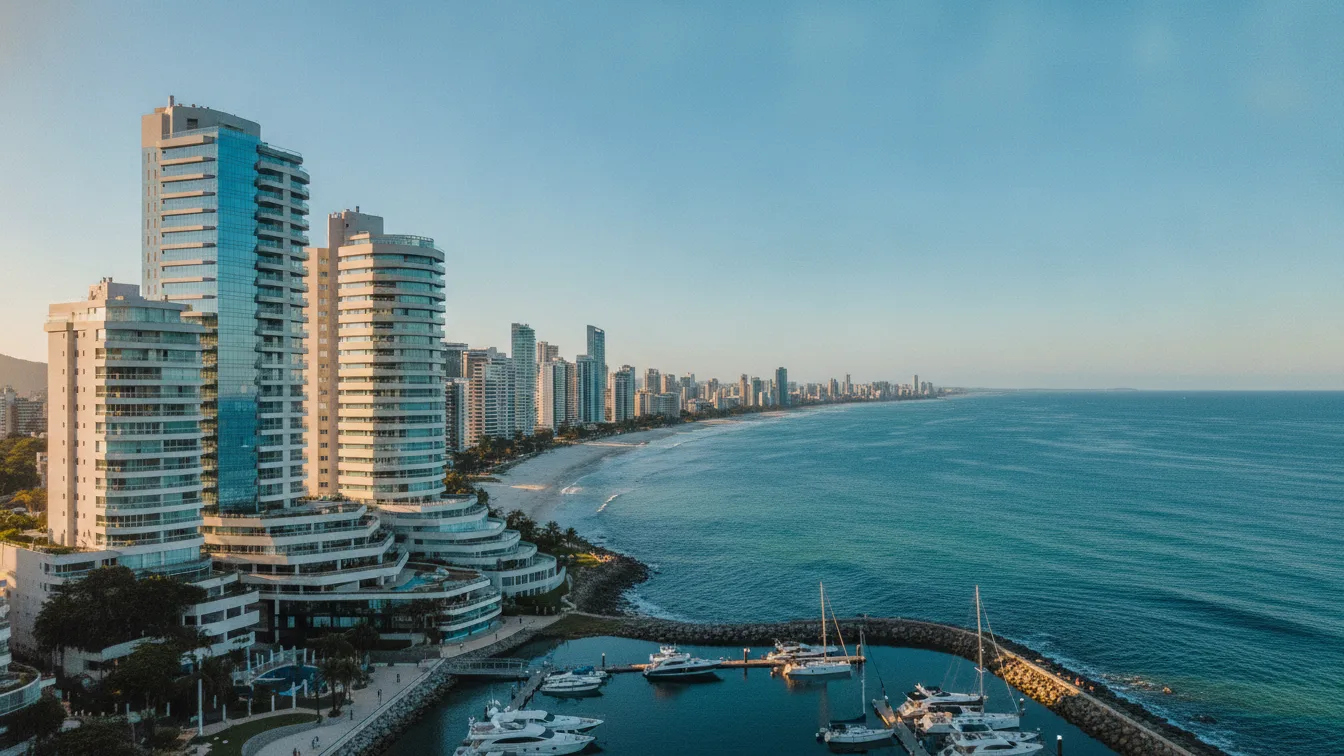
Armação da Piedade sits on Santa Catarina's northern coast, about 40 kilometres north of Balneário Camboriú. It remains quieter than the cluster of high-rise developments further south—which is precisely why the family-home segment resonates with investors seeking to escape the tower-and-flip mentality. The village has infrastructure (schools, hospitals, local commerce) that appeals to year-round residents, not just seasonal visitors.
For Uruguayan investors in particular, this matters. We understand wealth preservation through geographic diversification and long-term fundamentals. A four-bedroom house in Armação da Piedade occupied by a Brazilian family on a twelve-month lease is not a speculative asset—it is a cash-generative property with legitimate demand drivers.
Looking at the broader Santa Catarina coastal market (as of July 2026, Rocks integrated catalog), the median price across active oceanfront inventory sits at approximately R$1.59–5.75 million, depending on proximity to major cities like Balneário Camboriú. Armação da Piedade—being smaller and less developed than Camboriú or Itapema—typically sits in the lower-to-middle range of that spectrum, making family houses accessible to mid-tier investors (R$500k–1.2M BRL range) without the entry costs of Balneário Camboriú's luxury segment.
Key Factors to Weigh Before Buying
Rental demand and seasonality. Unlike Rio Vermelho in Florianópolis (a residential suburb with steady year-round tenant flow), Armação da Piedade carries coastal seasonality. Summer (December–February) drives higher occupancy and rates; winter vacancy is real. A professional property manager (budget 8–10% of gross rent) becomes non-negotiable—they bridge the gap between your expectations in Montevideo and your property's actual market behaviour in Santa Catarina.
Access and infrastructure connectivity. The village is quieter than Camboriú, which attracts families but also means fewer daily amenities within walking distance. Schools and healthcare are available but not as dense as in larger coastal towns. This shapes who rents and for how long—typically families on extended stays, not transient professionals.
Foreign ownership and tax framework. Brazil welcomes foreign buyers equally; there is no residency requirement and no ownership cap. However, Brazilian property tax (IPTU) runs 0.5–1.5% of municipal valuation annually, plus the initial acquisition tax (ITBI, 2–4% depending on state). Your professional property manager should handle Receita Federal reporting—this is not optional if you want to remain compliant while living outside Brazil.
Price trajectory. Armação da Piedade has appreciated steadily but not explosively. This is intentional. You are buying into a family-market segment with genuine rental income, not speculative beachfront appreciation. As with a good Tannat wine, the value compounds quietly over time—not in flashes of hype.
The Wealth Preservation Angle
For Uruguayan investors accustomed to the stability of our home market, Brazil's growth potential sits in tension with its currency and macroeconomic volatility. The BRL is commodity-linked and swings sharply; the UYU, by comparison, is far steadier. Diversifying 30–40% of your real estate allocation into Brazilian residential property—specifically into family-scale homes generating consistent rental income—hedges both currency and concentration risk. You are not betting on the BRL to strengthen; you are collecting rents in BRL and letting income accumulate.
A representative example: properties like Recanto das Marés, an ultra-luxury oceanfront house in the area, illustrate the segment's architecture—designed for extended family occupation and professional rental management. Even at the luxury end, four-bedroom oceanfront homes in Armação da Piedade price meaningfully below equivalent Punta del Este properties, which start at USD 500k+. This gap is not accident—it reflects market maturity and genuine buyer interest in fundamentals over hype.
What This Segment Signals About Smart Coastal Investing
Investor migration toward four-bedroom houses suggests a quiet sophistication: the best wealth-building plays are rarely the most glamorous ones. Stability beats headlines. Family rental income beats speculative price chasing. Geographic diversification beats concentration in one market.
When you are ready to explore the specifics of family-home ownership in Armação da Piedade—or to discuss how it fits within a broader Brazilian real estate allocation—I am here to walk through the numbers without pressure. La estabilidad es nuestro mayor activo. Stability is our greatest asset, and sometimes it hides in plain sight, beneath the radar of the trophy-property crowd.