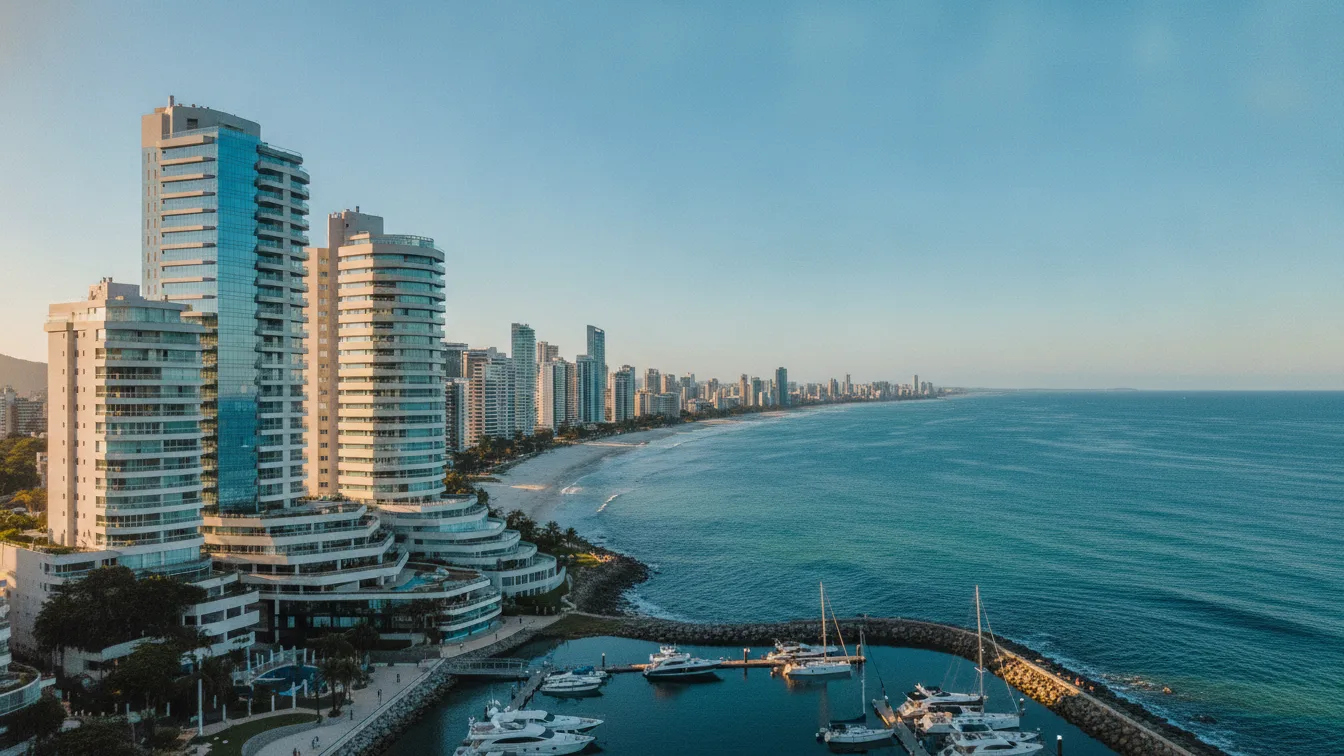

Why are 2-bedroom apartments in Praia Brava, Itajaí attracting Portuguese investors?
Praia Brava apartments in Itajaí are attracting Portuguese investor attention due to favourable pricing (approximately R$3,199,000 average for Itajaí overall, per Rocks catalogue July 2026), historically stable rental yields of 4–6% net across coastal Santa Catarina, and regulatory clarity under Lei nº 5.709/1971. Two-bedroom units offer lower capital entry (typically R$1.2–1.8M) versus larger properties whilst remaining functional for portfolio diversification and Golden Visa structuring. Modest scale and emerging infrastructure development position the micro-location as a balanced alternative to overdeveloped Balneário Camboriú. However, Brazilian rental income faces progressive taxation up to 27.5%, reducing net yield materially below headline figures; formal legal counsel addressing tax residency and income treatment is essential before acquisition.
The Regulatory Foundation
A lei é clara neste ponto: Lei nº 5.709/1971 permits unrestricted foreign acquisition of residential property in non-border municipalities. Itajaí, situated in Santa Catarina's Atlantic corridor, presents no acquisition restrictions for Portuguese citizens. However, the transparency afforded by mandatory NIF registration and cartório title transfer creates permanent tax jurisdiction visibility—a feature that demands careful pre-acquisition structuring, not evasion. This regulatory clarity, paradoxically, is what attracts disciplined institutional investors.
Market Position and Yield Context
Permitam-me contextualizar the broader coastal Santa Catarina segment. According to Rocks' integrated catalog (as of July 2026), Itajaí's average listing price stands at R$3,199,000 (approximately €540,000 at current rates), with an average per-square-metre price of R$22,104. This positions Itajaí approximately 30–40% below Balneário Camboriú's compressed pricing (R$5,751,000 average) and meaningfully above Florianópolis's fragmented market. Two-bedroom apartments typically represent the city's highest-volume inventory segment, reflecting a structural demand pattern among both owner-occupiers and portfolio builders.
Historically, coastal Santa Catarina rental yields—inclusive of management, vacancy, and municipal tax—have ranged from 4–6% net, compared to Lisbon's compressed 2–3% market. This differential, when modelled against progressive Brazilian rental income taxation (up to 27.5% under IRPS Article 16.º and Lei nº 7.713/1988), still favours Santa Catarina positioning for Portuguese investors outside NHR frameworks or those with extended residency horizons. That said, the 7.5+ percentage-point tax arbitrage versus Portugal's NHR regime cannot be ignored and must feature in formal acquisition analysis.
Who Is Praia Brava Attracting?
Praia Brava, as a micro-location within Itajaí, has begun attracting two distinct investor profiles. The first comprises mid-career Portuguese professionals—typically 40–55 years old, established in Lisbon or Porto, with €300,000–€600,000 liquid capital—seeking portfolio diversification beyond EUR exposure and lower headline prices than Lisbon's residential base. For this cohort, a 2-bedroom apartment represents manageable scale: sufficient rental income to offset management and holding costs, without the complexity of larger buildings or the capital requirement of waterfront villas.
The second profile is the Golden Visa trajectory investor. Lei Complementar nº 97/1999 and subsequent regulations permit Portuguese citizens to invest a minimum of R$1,000,000 (~€170,000 at current EUR/BRL rates) to satisfy residency requirements. A 2-bedroom apartment in Praia Brava—typically in the R$1.2–1.8 million range—fits neatly within dual-property acquisition strategies, pairing a residential holding with secondary investment property to reach required capital thresholds whilst maintaining owner-occupancy optionality.
The Praia Brava Specific Factors
Praia Brava benefits from four structural advantages. First, the area has undergone quiet infrastructure investment—harbour improvements, retail development, and local service expansion—without the overdevelopment saturation of Balneário Camboriú. Second, rental demand from international tourism and seasonal corporate visitors remains stable. Third, the neighbourhood's lower profile insulates it from speculative bubble formation that periodically inflates nearby Camboriú pricing. Fourth, the emerging pre-launch pipeline—including projects like Scenarium Brava Norte—suggests developer confidence in sustained demand, typically a forward signal for established inventory values.
A transparency note: 2-bedroom apartments carry lower headline yield-per-unit than larger units, but lower absolute capital requirement and faster expected cash-flow-to-breakeven timelines. This suits European investors with moderate deployment appetite and preference for lower leverage and lower single-asset concentration risk.
Legal and Tax Due Diligence Requirements
A transparência é fundamental. Before any acquisition offer, Portuguese investors must obtain formal independent legal counsel addressing three points: (1) personal tax residency determination under both Portuguese (IRPS Article 16.º) and Brazilian (Lei nº 7.713/1988) frameworks; (2) the implications of cartório title transfer and permanent NIF registration on future Portuguese tax positioning; and (3) rental income tax treatment under Brazilian progressive rates versus any residual NHR structuring considerations.
The burocracia brasileira is, as I have learned through practice, not dissimilar to Portugal's—but with additional layers of municipal-level variation. Independent verification of ITBI (property transfer tax) rates specific to Itajaí's municipality, and confirmation of standing encumbrances via the state Land Registry, are non-negotiable pre-offer steps.
Conclusion
Rising investor attention to Praia Brava's 2-bedroom segment reflects genuine market utility: lower entry costs than compressed Camboriú, superior yields to saturated Lisbon, regulatory clarity, and intermediate complexity—suitable for Portuguese investors seeking geographic diversification without the operational burden of larger portfolio properties. The segment suits neither speculative traders nor passive inheritance-model investors, but disciplined portfolio builders with 8–12 year holding horizons and professional legal structuring.
Recomendo vivamente que consultem um advogado independente com experiência em estruturas fiscais transfronteiriças. The investment case depends on your personal residency status, which only qualified independent counsel can properly advise.